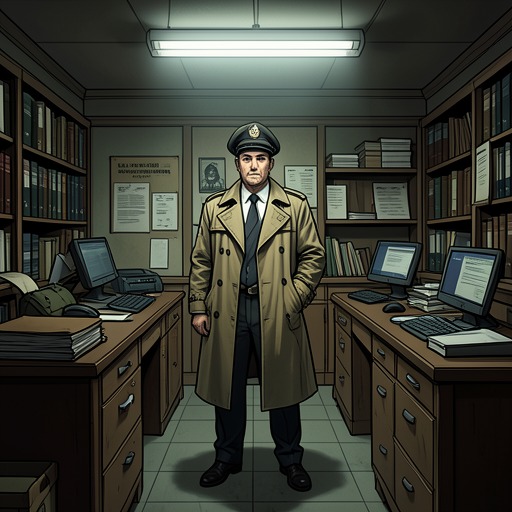
Armed Services Records and Identification
The Dark HalfArmed Services Records and Identification is the Washington agency that maintains and searches military service identification records. In the investigation into Homer Gamache’s murder, its computerized fingerprint search returns Thad Beaumont’s service record and identifies his prints at the crime scene. The result appears exact, not merely similar, and is checked against further prints connected to Frederick Clawson’s apartment. The agency supplies a consequential identification, but not an explanation for the apparent impossibility at its heart: Thad insists he was elsewhere, while the prints attributed to him are unusually clear and repeatedly match.
Role in the Investigation
When Alan Pangborn questions Thad, the agency’s fingerprint identification is the reason Thad has become a suspect. Pangborn tells him that if the identification proves to be an error, he will personally seek out the person at Armed Services Records and Identification responsible and hold that person accountable. A state trooper explains the agency’s full name and identifies its location as Washington. The exchange establishes the agency not as a local police unit but as an external records authority whose technical finding has entered a Maine murder investigation.
The case initially rests on physical evidence recovered from Homer Gamache’s truck, found in a Connecticut rest-stop parking lot near the New York border. Investigators find numerous fingerprints there. Among them are particularly clear impressions, including a print preserved in chewing gum on the dashboard and another on the rearview mirror, deposited in blood. Pangborn describes the latter as comparable in quality to a print made at a police station. The agency’s role is to compare such evidence with stored identification records; the crime-scene details, however, are gathered and interpreted by the investigators.
Identification and Rechecking
The first computerized search returns Thad’s service record—and, Pangborn says, Thad’s fingerprints. The finding stuns Thad and his wife, Liz Beaumont. Pangborn acknowledges that fingerprint identification can have gray areas and that the popular image of fingerprinting as infallible is misleading. But he emphasizes that computerization has reduced ambiguity and that the prints in this case are exceptionally good. Having examined both the computer sheets and overlays, he insists that the match is exact rather than approximate.
The finding is then checked again. Pangborn reports that the agency has reexamined the prints from Gamache’s truck and those from Frederick Clawson’s apartment. The latter impressions are not all as clear as the gum and mirror prints, but they also appear to match Thad’s prints exactly. Pangborn frames the implication as stark: if Thad did not commit the crimes, the evidence seems to require two people with precisely the same fingerprints. The repeated comparison strengthens the identification as a finding, while deepening the mystery of what it can establish about the person who left the prints.
Forensic Evidence and Its Limits
Thad does not simply deny the identification. He asks how the prints could be so decisive and whether the very quality of the evidence should invite suspicion. Drawing on research he conducted for his crime novels, he asks how many points of comparison are needed before fingerprints can be admitted as evidence. Pangborn answers that Maine requires six perfect comparisons. The exchange distinguishes the agency’s matching work from the legal threshold governing the prints’ admissibility in Maine: the agency’s result informs the investigation, while the state’s rule determines what comparison qualifies as evidence.
The distinction matters because the narrative supplies no ordinary explanation that reconciles the agency’s exact match with Thad’s account of his whereabouts. Pangborn considers the possibility that Thad has an identical twin who could have appeared at a gathering while Thad committed the murders, but Thad’s own account makes the theory implausible, and Liz confirms that their twins, William and Wendy, are a brother and sister rather than identical twins. The agency’s records cannot resolve that larger question. They establish the match investigators see in the prints; they do not establish when or how the prints were made.
Narrative Significance
The agency’s identification gives the investigation a firm-seeming technical foundation at the same time that it unsettles the ordinary relationship between evidence and identity. Pangborn initially believes Thad may be telling the truth, yet he cannot dismiss the print comparison. Thad, in turn, treats the unusually clean impressions as a clue rather than a simple confirmation of guilt. The conflict is not that the investigators lack a result, but that the result appears more exact than the circumstances can explain.
That tension persists as the investigation expands beyond fingerprints. Later, Pangborn receives voice-print results that are not what Thad expected, and he also recalls the mass of sparrows that struck the windows of Bergenfield County Hospital. He tries to resist a supernatural interpretation, telling himself that the evidence proves nothing of that kind, yet the combined anomalies unsettle him. In this structure, Armed Services Records and Identification represents the reach and limits of institutional verification: its comparison narrows the field of possibilities, but the exactness of its finding does not settle the story’s deeper question of who, or what, acted in Thad’s name.